Sustainable 3D Printing
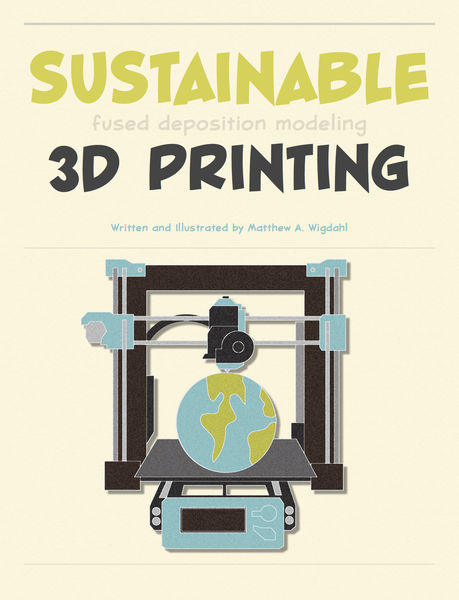
Have you considered how sustainable your design and 3D printing practice is? This book will offer you ideas on how to better implement a workflow to reduce, reuse and recycle.

Lifetime deals on AI tools & SaaS
Have you considered how sustainable your design and 3D printing practice is? This book will offer you ideas on how to better implement a workflow to reduce, reuse and recycle.

Please Disable Adblock to Show Download Link
DOWNLOAD
Author : Bhasha Sharma
Genre : Technology & Engineering
Summary : This book highlights 3D-printed biopolymers’ advancements and sustainability, exploring cutting-edge research and real-world applications. Biopolymers have garnered global interest due to environmental concerns and are widely utilized in applications such as biomedicine, food, textiles, and cosmetics. Techniques like 3D printing have been extensively studied to fabricate reliable and efficient products, particularly in tissue engineering. These techniques enable the production of materials with complex structures and diverse functional groups. The book provides a comprehensive account of contemporary advancements in 3D-printed biopolymers, emphasizing their role in promoting sustainability and supporting the circular economy. Featuring meticulously curated chapters by leading scientists, it integrates diverse disciplines, including green biopolymers, nanotechnology, functionalization techniques, and material synthesis, offering a holistic understanding of the field. Several chapters delve into 3D printing processing techniques and their applications in areas such as water purification, energy storage, and biomedical advancements. Additionally, the book addresses progress in biopolymer technology, exploring its challenges and future prospects. Audience This book is ideal for industrial manufacturers, environmental chemists, materials and biopolymer scientists, and researchers in industries such as biomedicine, food, textiles, packaging, and cosmetics.

Please Disable Adblock to Show Download Link
DOWNLOAD
Author : Ad J.M. van Wijk
Genre : Technology & Engineering
Summary : Additive manufacturing or 3D printing, manufacturing a product layer by layer, offers large design freedom and faster product development cycles, as well as low startup cost of production, on-demand production and local production. In principle, any product could be made by additive manufacturing. Even food and living organic cells can be printed. We can create, design and manufacture what we want at the location we want. 3D printing will create a revolution in manufacturing, a real paradigm change. 3D printing holds the promise to manufacture with less waste and energy. We can print metals, ceramics, sand, synthetic materials such as plastics, food or living cells. However, the production of plastics is nowadays based on fossil fuels. And that’s where we witness a paradigm change too. The production of these synthetic materials can be based also on biomaterials with biomass as feedstock. A wealth of new and innovative products are emerging when we combine these two paradigm changes: 3D printing and biomaterials. Moreover, the combination of 3D printing with biomaterials holds the promise to realize a truly sustainable and circular economy.

Please Disable Adblock to Show Download Link
DOWNLOAD
Author : Kamalpreet Sandhu
Genre : Technology & Engineering
Summary : With advancement in modern technology human life span in 21st century has significantly improved as compared to past centuries. Indeed, the manufacturing and household wastes have also boosted in the same era, presenting a hazardous condition to the various living beings. However, through smart methodologies, it can be possible to recycle/reuse of the different types of wastes as a feedstock convenient for specialized manufacturing technologies, such as 3D printing. This means that through proper facilities the waste can be used as the raw material for the printing technologies with characteristic at par with the virgin feedstock. Furthermore, producing the feedstock using waste materials will help to reduce the cost of the processing material, productivity and eco-friendliness of this manufacturing technology. This book will cover a boarder aspect of such efforts wherein various applications and state of art solutions will be discussed in a comprehensive way. This book will be much interest for academics, research and entrepreneur who are working in the field materials science, 3D printing, and manufacturing because of its coverage of state of art solution in the field of commercial, industrial and healthcare products.

Please Disable Adblock to Show Download Link
DOWNLOAD
Author : Mir Irfan Ul Haq
Genre : Technology & Engineering
Summary : The text focuses on the role and the importance of 3D printing in new product development processes. It covers various aspects such as the 3D printing revolution and Industry 4.0, sustainability and 3D printing, and economics of 3D printing. It discusses important concepts, including 3D printing, rapid prototyping, mechanical and physical properties of 3D printed parts, nanomaterials, and material aspects of 3D printing. Features 1. Presents recent advances such as Industry 4.0, 4D printing, 3D material mechanical characterization, and printing of advanced materials. 2. Highlights the interdisciplinary aspects of 3D printing, particularly in biomedical, and aerospace engineering. 3. Discusses mechanical and physical properties of 3D printed parts, material aspects, and process parameters. 4. Showcases topics such as rapid prototyping, medical equipment design, and biomimetics related to the role of 3D printing in new product development. 5.Covers applications of 3D printing in diverse areas, including automotive, aerospace engineering, medical, and marine industry. It will serve as an ideal reference text for senior undergraduate, graduate students, and researchers in diverse engineering domains, including manufacturing, mechanical, aerospace, automotive, and industrial.

Please Disable Adblock to Show Download Link
DOWNLOAD
Author : Daina Baker
Genre :
Summary : Sustainable manufacturing practices have been an essential consideration in recent years. 3D printing will be a key technology in the transition towards sustainability because it minimizes material consumption and waste generation. One area that could benefit from 3D printing techniques would be the production of printed circuit boards and electronics in which most of the copper used is etched in subsequent steps. Comparatively, 3D printing minimizes waste by depositing conductive material only where desired. However, the conductive material used, commonly a silver-based printable material, is expensive and further reductions are required to ensure sustainability. In high frequency applications, owing to the skin effect, the core of a conductor carries little electrical current and thus could be replaced with a cheaper plastic. To accomplish this, custom nozzles capable of printing these sheath conductors were developed and tested by printing an embedded inductor for wireless power transfer.

Please Disable Adblock to Show Download Link
DOWNLOAD
Author : Mark Von Rosing
Genre : Social Science
Summary : The Sustainability Handbook provides a comprehensive and holistic understanding of sustainability, bridging the gap between academic theory and business practices. Global climate change poses enormous environmental challenges, and societies across the world must adapt and innovate to further the goals of sustainability for present and future generations. The private sector especially must find new ways of doing business to align their practices with the Sustainable Development Goals (SDGs) adopted by the international community. Using a conceptually structured framework throughout, the book examines the latest academic research to summarize what environmental, social, and economic sustainability actually means in different contexts. Using numerous specific case studies and insights from industry leaders, the book shows how to strategically integrate sustainability into the organization, with extensive focus on policies, incentives, measures, operations, production, consumption, and lifecycle management. Volume 2 explores the concept of Radical Sustainability within an enterprise and why it is needed. With examples from zero waste to eliminating use of rare earth resources, triggering sustainable practices to cause related marketing, and sustainability responsibility to external transparency over internal incidents, this volume offers practical solutions for those who desire to progress from a Sustainable Strategy to an effective Sustainability Portfolio Management approach. Underpinned by international research-based evidence, it explores associated trends and drivers within the marketplace and how innovative environmental, social, economic and governance aspects can be considered and solutions applied. For researchers, students, and businesspeople at all levels and sectors, this handbook is an essential reference of the latest sustainability tools and methodologies required to adapt and innovate towards sustainability. - Provides step-by-step guidance on key procedures and methodologies - Presents chapters that begin with a graphical representation of how the topic fits within the larger framework - Includes extensive coverage of sustainability-related case studies and lessons learned

Please Disable Adblock to Show Download Link
DOWNLOAD
Author : C. Anandharamakrishnan
Genre : Technology & Engineering
Summary : 3D Printing of Foods “p>Explore the fascinating realm of 3D food printing and its applications In 3D Printing of Foods, a team of distinguished researchers delivers a comprehensive and eye-opening exploration of the rapidly developing field of 3D food printing. In the book, the authors offer readers an examination of “food printability,” the foundation of 3D food printing. They discuss the enormous research gap in the subject that remains to be addressed and envisage a robust discipline in which food processing techniques, combined with 3D food printing, gives rise to a range of synergistic applications. In addition to treatments of safety challenges and research requirements, the book tackles food industry market trends and consumer preferences, as well as the globalization of printed foods and consumer perception of 3D printed foods. 3D Printing of Foods also explores the integration of electrohydrodynamic processes and encapsulation with 3D food printing. Readers will also find: Thorough introductions to 3D printing technology, 3D printing approaches, and food components and their printability In-depth examinations of the factors affecting the printability of foods, printability and techniques, and natively printable foods Practical discussions of pre-processing of non-printable foods and alternative ingredients used in food printing Comprehensive explorations of 4D printing technology and the applications of 3D food printing technology Perfect for 3D printing professionals and enthusiasts, as well as food scientists, 3D Printing of Foods is an indispensable resource for anyone interested in a one-stop resource addressing this cutting-edge technology with nearly limitless potential.