DJI Mini 4 Pro Review: Is It Still the Best Drone for Beginners in 2026?
When DJI launched the Mini 4 Pro in late 2023, it immediately became the benchmark for consumer drones under 250 grams. It combined a capable camera, intelligent flight modes, omnidirectional obstacle sensing, and a compact form factor at a price point that was accessible to hobbyists and serious content creators alike.
Now in 2026, a legitimate question arises: with newer drones entering the market every few months, is the Mini 4 Pro still worth buying? Or has it been overtaken by better alternatives?
After putting it through months of real-world testing across a variety of conditions — coastal beaches, dense urban areas, open fields, and low-light environments — here is our comprehensive verdict.
Design and Build Quality
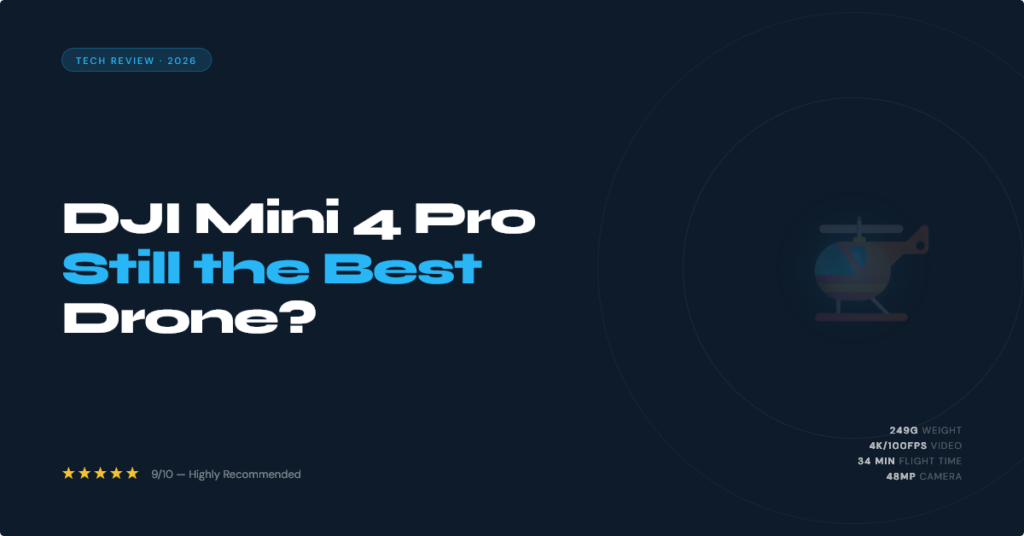
The DJI Mini 4 Pro weighs just 249 grams, which places it below the registration threshold in most countries including the United States, the United Kingdom, and much of Europe. This is not a minor convenience — it means you can fly in many locations that would otherwise require paperwork, fees, and advance planning.
The drone folds into a compact, pocket-friendly form. The build quality is excellent for its weight class — the frame feels solid, the motors are well-protected, and the gimbal is housed securely. It doesn’t feel like a toy. The matte gray finish is clean and professional-looking.
One minor criticism is that the plastic body can feel slightly hollow when you tap it, but this is a necessary trade-off to keep the weight under 250 grams.
Camera Performance
The camera is the heart of any drone, and the Mini 4 Pro delivers impressively. It shoots 4K video at up to 100fps, 4K slow motion at 100fps, and captures 48-megapixel still photos. The 1/1.3-inch CMOS sensor is one of the largest in its weight class, and it shows in real-world performance.
Low-light footage is noticeably cleaner than earlier DJI Mini models. The f/1.7 aperture lets in significantly more light than the f/2.8 found on the Mini 3, making evening and dusk shots genuinely usable without heavy noise reduction in post.
Color science is excellent out of the box, and the D-Log M profile gives you substantial flexibility in color grading if you shoot for professional projects. The 10-bit color support is a welcome addition for videographers who want cinematic-grade footage.
Obstacle Avoidance
This is where the Mini 4 Pro truly separates itself from its predecessors. It features omnidirectional obstacle sensing — meaning it detects obstacles in front, behind, above, below, and to the sides. Earlier Mini models had only forward and downward sensing, which made autonomous flight modes risky.
With full omnidirectional sensing, the drone can now execute complex autonomous maneuvers — like ActiveTrack and FocusTrack — with far greater confidence. For beginners especially, this dramatically reduces the risk of expensive crashes.
Intelligent Flight Modes
The Mini 4 Pro comes with an impressive suite of automated shooting modes:
ActiveTrack 360 — Tracks a moving subject while orbiting or following, with obstacle avoidance active throughout.
Hyperlapse — Captures time-lapse videos in Free, Circle, Course Lock, and Waypoint modes.
MasterShots — Automatically executes a series of cinematic maneuvers and edits them into a finished short video.
QuickShots — Pre-programmed moves like Dronie, Helix, Rocket, and Boomerang that produce polished results with one tap.
Cruise Control — Locks your speed and direction so you can focus entirely on camera work. This is surprisingly useful for smooth cinematic tracking shots.
Flight Time and Controller
Battery life is rated at 34 minutes per charge. In real-world conditions with moderate wind, you’ll typically see 28 to 30 minutes — which is still excellent. DJI sells the Fly More Combo with three batteries included, which gives you roughly 90 minutes of total flight time per outing.
The RC-2 controller with its built-in 5.5-inch screen is a standout feature. No phone mounting required, no worrying about sun glare on your phone screen, and no battery drain on your personal device. The controller itself is bright, responsive, and comfortable to hold for extended sessions.
Price and Value
The DJI Mini 4 Pro starts at approximately $759 for the standard combo with one battery and the RC-2 controller. The Fly More Combo retails at around $959 and includes three batteries, a charging hub, ND filter set, and a carrying bag.
While these prices aren’t cheap for a beginner drone, the value proposition is strong. You’re getting flagship camera features, best-in-class safety systems, and a proven, reliable platform that DJI continues to support with firmware updates.
Who Should Buy the DJI Mini 4 Pro in 2026?
The Mini 4 Pro is ideal for travel content creators, hobbyists who want stunning footage without a steep learning curve, and anyone who needs to fly legally in weight-restricted areas. It’s also a capable tool for real estate videography and event coverage.
If you need a larger sensor, look at the DJI Air 3. If you’re doing fully professional commercial work, the Mavic 3 Pro is worth the upgrade. But for the vast majority of users, the Mini 4 Pro hits the perfect balance.
Verdict
The DJI Mini 4 Pro remains one of the best drones you can buy in 2026. It hasn’t been dethroned — it’s still the gold standard for sub-250g drones, and its combination of portability, camera quality, and safety features is hard to beat at this price point.
Rating: 9/10 — Highly Recommended


