Universal Artificial Intelligence
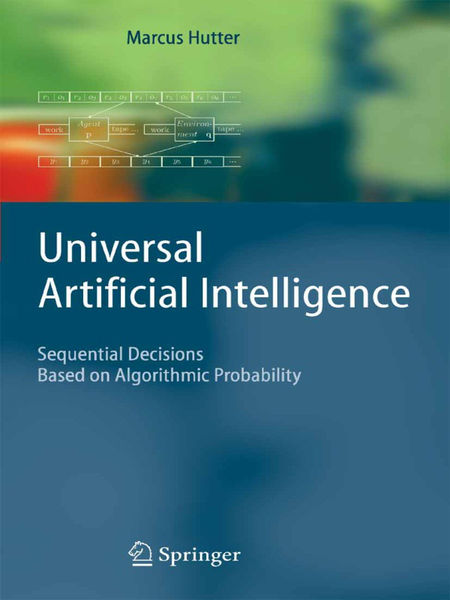
Decision Theory = Probability + Utility Theory
+ +
Universal Induction = Ockham + Bayes + Turing
…

Lifetime deals on AI tools & SaaS
Decision Theory = Probability + Utility Theory
+ +
Universal Induction = Ockham + Bayes + Turing
…

Please Disable Adblock to Show Download Link
DOWNLOAD
Author : Marcus Hutter
Genre : Computers
Summary : Personal motivation. The dream of creating artificial devices that reach or outperform human inteUigence is an old one. It is also one of the dreams of my youth, which have never left me. What makes this challenge so interesting? A solution would have enormous implications on our society, and there are reasons to believe that the AI problem can be solved in my expected lifetime. So, it's worth sticking to it for a lifetime, even if it takes 30 years or so to reap the benefits. The AI problem. The science of artificial intelligence (AI) may be defined as the construction of intelligent systems and their analysis. A natural definition of a system is anything that has an input and an output stream. Intelligence is more complicated. It can have many faces like creativity, solving prob lems, pattern recognition, classification, learning, induction, deduction, build ing analogies, optimization, surviving in an environment, language processing, and knowledge. A formal definition incorporating every aspect of intelligence, however, seems difficult. Most, if not all known facets of intelligence can be formulated as goal driven or, more precisely, as maximizing some utility func tion. It is, therefore, sufficient to study goal-driven AI; e. g. the (biological) goal of animals and humans is to survive and spread. The goal of AI systems should be to be useful to humans.

Please Disable Adblock to Show Download Link
DOWNLOAD
Author : Marcus Hutter
Genre : Computers
Summary : Personal motivation. The dream of creating artificial devices that reach or outperform human inteUigence is an old one. It is also one of the dreams of my youth, which have never left me. What makes this challenge so interesting? A solution would have enormous implications on our society, and there are reasons to believe that the AI problem can be solved in my expected lifetime. So, it's worth sticking to it for a lifetime, even if it takes 30 years or so to reap the benefits. The AI problem. The science of artificial intelligence (AI) may be defined as the construction of intelligent systems and their analysis. A natural definition of a system is anything that has an input and an output stream. Intelligence is more complicated. It can have many faces like creativity, solving prob lems, pattern recognition, classification, learning, induction, deduction, build ing analogies, optimization, surviving in an environment, language processing, and knowledge. A formal definition incorporating every aspect of intelligence, however, seems difficult. Most, if not all known facets of intelligence can be formulated as goal driven or, more precisely, as maximizing some utility func tion. It is, therefore, sufficient to study goal-driven AI; e. g. the (biological) goal of animals and humans is to survive and spread. The goal of AI systems should be to be useful to humans.

Please Disable Adblock to Show Download Link
DOWNLOAD
Author : Marcus Hutter
Genre : Computers
Summary : An Introduction to Universal Artificial Intelligence provides the formal underpinning of what it means for an agent to act intelligently in an unknown environment. First presented in Universal Algorithmic Intelligence (Hutter, 2000), UAI offers a framework in which virtually all AI problems can be formulated, and a theory of how to solve them. UAI unifies ideas from sequential decision theory, Bayesian inference, and algorithmic information theory to construct AIXI, an optimal reinforcement learning agent that learns to act optimally in unknown environments. AIXI is the theoretical gold standard for intelligent behavior. The book covers both the theoretical and practical aspects of UAI. Bayesian updating can be done efficiently with context tree weighting, and planning can be approximated by sampling with Monte Carlo tree search. It provides algorithms for the reader to implement, and experimental results to compare against. These algorithms are used to approximate AIXI. The book ends with a philosophical discussion of Artificial General Intelligence: Can super-intelligent agents even be constructed? Is it inevitable that they will be constructed, and what are the potential consequences? This text is suitable for late undergraduate students. It provides an extensive chapter to fill in the required mathematics, probability, information, and computability theory background. You can also visit the author website: http://www.hutter1.net/ai/uaibook2.htm.

Please Disable Adblock to Show Download Link
DOWNLOAD
Author : Marcus Hutter
Genre : Computers
Summary : Personal motivation. The dream of creating artificial devices that reach or outperform human inteUigence is an old one. It is also one of the dreams of my youth, which have never left me. What makes this challenge so interesting? A solution would have enormous implications on our society, and there are reasons to believe that the AI problem can be solved in my expected lifetime. So, it's worth sticking to it for a lifetime, even if it takes 30 years or so to reap the benefits. The AI problem. The science of artificial intelligence (AI) may be defined as the construction of intelligent systems and their analysis. A natural definition of a system is anything that has an input and an output stream. Intelligence is more complicated. It can have many faces like creativity, solving prob lems, pattern recognition, classification, learning, induction, deduction, build ing analogies, optimization, surviving in an environment, language processing, and knowledge. A formal definition incorporating every aspect of intelligence, however, seems difficult. Most, if not all known facets of intelligence can be formulated as goal driven or, more precisely, as maximizing some utility func tion. It is, therefore, sufficient to study goal-driven AI; e. g. the (biological) goal of animals and humans is to survive and spread. The goal of AI systems should be to be useful to humans.

Please Disable Adblock to Show Download Link
DOWNLOAD
Author : Marcus Hutter
Genre : Computers
Summary : Personal motivation. The dream of creating artificial devices that reach or outperform human inteUigence is an old one. It is also one of the dreams of my youth, which have never left me. What makes this challenge so interesting? A solution would have enormous implications on our society, and there are reasons to believe that the AI problem can be solved in my expected lifetime. So, it's worth sticking to it for a lifetime, even if it takes 30 years or so to reap the benefits. The AI problem. The science of artificial intelligence (AI) may be defined as the construction of intelligent systems and their analysis. A natural definition of a system is anything that has an input and an output stream. Intelligence is more complicated. It can have many faces like creativity, solving prob lems, pattern recognition, classification, learning, induction, deduction, build ing analogies, optimization, surviving in an environment, language processing, and knowledge. A formal definition incorporating every aspect of intelligence, however, seems difficult. Most, if not all known facets of intelligence can be formulated as goal driven or, more precisely, as maximizing some utility func tion. It is, therefore, sufficient to study goal-driven AI; e. g. the (biological) goal of animals and humans is to survive and spread. The goal of AI systems should be to be useful to humans.

Please Disable Adblock to Show Download Link
DOWNLOAD
Author : Boris Aberšek
Genre : Philosophy
Summary : This book presents the Sartrean thesis that existential questions cannot be definitively answered, as each generation must revisit them. Rooted in Renaissance humanism, questions about human existence and society persist. Existentialism emerged from early 20th-century chaos, emphasizing the relationship between being-for-itself and being-in-itself. Today, the clarity of this relationship is lost amid modern chaos. We now inhabit two worlds: the physical and cyberspace, and face two entities: humans and AI-based artificial life forms (ALF), creating constant tension. While 20th-century existential questions remain, answers have grown more complex. Future discussions about humanity must consider the interplay between physical and cyber worlds, and between humans and ALFs. This book employs original Existentialist language to address current existential questions, developing a philosophy we call Existentialism 2.0. Humanity must find its place in the future, or risk losing its essence as we know it.

Please Disable Adblock to Show Download Link
DOWNLOAD
Author :
Genre : Artificial Intelligence
Summary :